Saturday, September 20, 2008

Reprint: Twin Keels Shoal Havens


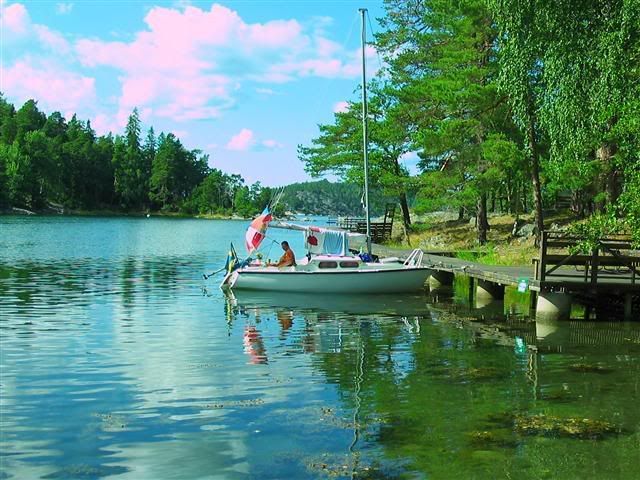
I received a letter from former Twin Keeler editor Craig Anderson with some paper copies of articles from the old days when T-K was a paper newsletter. As those issues now are out of print he proposed re-printing them online and I will gladly oblige. The first one is by Phil Teece from Canada who sailed his little twin keeler i British Columbia on the Pacific Coast.

All afternoon I had drifted slowly up Haro Strait in a gentle following breeze. I was not alone on this long, broad waterway, which separates the Canadian Vancouver Island from the American San Juans. The perfect weather of late summer had spawned a fleet of several dozen boats, all ghosting northward in the light airs. By sundown all of us would seek our night anchorage among the nearest of British Columbia's Gulf Islands.
As evening approached, the first of the islands began to cluster around us. I wondered if I might find, somewhere, a haven in which to drop my hook in solitude, for the convivality of a thronging cove has never appealed to me. When in a mere breath of stirring air, I inched past the entrance of Sidney Island's popular lagoon, I saw that most of the fleet of larger craft had already arrived. A crush of vessels all in close ranks along the lines of mooring buoys, lay surrounded by a swarm of outboard-powered dinghies that buzzed like flies about the anchorage. To say the place seemed uninviting would be a profound understatement.
Ahead lay Portland Island, marine park. Approaching it, I saw that its principal anchorage bristled with masts. I passed by, unwilling even in the gathering dusk to end so peaceful a day in a haven so sociable. Up along that island's rocky eastern shore, however, there is a sort of notch - a gap in the wall. Only a bit wider than my boat herself with about two feet of depth at high water over a rough gravel bottom, this was a place at which no yachtsman would even glance in passing. But Galadriel is an 18-foot microcruiser fitted with twin keels that draw only two feet. When the tide withdrew from that little cranny, my tiny twin-keeler would lie happily and safely aground on the firm, stony bottom.
I drifted into that place, anchoring when my little sloop's ironshod heels just touched ground. There, during a warm glowing night at the height of the summer cruising season, I was alone, enjoying a delicious deep silence. While all the larger craft lay pressed closely together in the popluar deepwater anchorages, I had found my way into an alternative world that could easily have been on a separate planet.

Continue to part II

Tuesday, September 16, 2008

Silhouette blog


Ed Hughes sent us an email promoting his blog about Misty, his Silhouette Mk3. He sails her in the Solent in the UK. The blog tells the story of how he acquired the boat, restored her and now sails her. It also contains a lot of pictures and video clips.
http://www.silhouette-misty.blogspot.com/

Friday, September 12, 2008

The Learning Curve


As a consultant I have become quite familiar with the learning curve. In fact, it’s what keeps me in business.

My clients hire me, not because I know everything about their business or their technology, but because I can pick it up faster than most people. When I start on a project, lots of decisions have already been made. Almost always, the software package has been selected. Often the implementation team has been assembled. Sometimes the project methodology has been selected. Once in a while the project has actually begun.

So I seldom get to run a project from scratch. In addition to learning about the business rationale and the budget, I generally have to learn what’s been done right, what’s been done wrong, what can be fixed, and what has to be thrown out. It’s exciting and challenging.

It helps that I’m both curious and analytic. Where is the data for this application coming from? Where is it going? What kinds of business was this application designed for? What has to be done to adapt it to this business? Who needs to be kept in the loop on the project? The answers to all these questions may be different from what I expect, or even what people on the project tell me, but the answers are essential. Lots to learn!

Well, it turns out that the same learning curve applies to buying a boat; more so a used boat, and even more so a boat bought on Ebay. But that’s just what I did, so I am now climbing up yet another curve.

This one began before I bought the boat, a Ranger 26. Actually, it began many years ago, as I was researching some interesting older brands, and noticed the rave reviews of boats designed by Gary Mull. That bit of data was stored in the back of my memory, ready to pop up when I saw this boat on Ebay in the middle of the summer.

Having looked at hundreds of boats on Ebay, and having bid on a few, I felt pretty confident of what I’d bought, especially at the price I paid. But there’s nothing like the first visit to what is now your boat to get your heart started.

This time, everything worked out. A cursory inspection revealed no obvious problems except a rather chalky gelcoat. There was even a ladder lying under the boat, so I climbed aboard. Here, too, the news was mostly good. The previous owner had obviously taken good care of her.

The Lexan hatchboards, massive compared to my Alacrity’s plywood one, revealed a real saloon, not the tiny cuddy in the Alacrity, although I still couldn’t stand erect in it. And a real head, instead of a Porta-Potty. I wanted to explore everything, but first I needed to launch her so the summer storage charges would stop accumulating.

That meant some exterior work, such as removing the old name (Moon Dance) and replacing it with Greyhound. One thing I learned right away is that lettering looks much bigger on the boat than it does in the catalog.

Another thing I learned was that a fin-keeler is much easier to bottom-paint than a twin keeler – no more crawling between the trailer and the hull, painting upside down over my head. With a quick coat of anti-fouling and some cursory polishing of the topsides, I was ready to get out of the boatyard and back to my marina.

Well, almost. First I had to rig her. The genoa had a luff tape designed for the Furlex furler, but I had never raised it before, so I spent a frustrating hour unjamming the tape when I wasn’t careful enough. But it was finally up and furled, and I brought Brian, an experienced sailor, to help me get her downriver to her new home.

A good thing, too. I planned our sail to coincide with the ebb tide, figuring that we’d need help in the typical Hudson summer zephyrs. Instead we pounded through 20-knot breezes right on the nose, with the bow wave washing over the foot of the jib until I had the good sense to reef it after an hour or so. Sometimes the learning curve is pretty steep. On the other hand, I discovered quite by accident that the Barient primaries were actually two-speeds. Sometimes there is no learning curve at all.

With Greyhound safely in her berth, I really began ascending the learning curve. I discovered a wasps’ nest in the lazarette vent when I was routing the fuel lines for the outboard. Oops! I couldn’t flush the toilet until I opened the valve that lets in the seawater. Hmm! I finally discovered the water tank under one of the settees by tracing the tubing from the sink, and filled it with the hose. Awright!

Gradually, Greyhound is becoming less of a stranger and more of a friend. She sails like a dream – I can stand in the companionway while she steers herself, with only a nudge or two on the tiller with my knee to keep her on course.

There is still a lot to learn, of course. Brian got the depth sounder working, but not the knot meter, while we were sailing down the river, but I haven’t been able to get any of the electricals to work. I still have to trace all the wiring and piping under the berths and settees – who knows what I’ll find there. And I bought a plow anchor, a rode and a roller, but I haven’t figured out how or where to mount them yet.

Right now, though, I really want to learn by sailing. I want to nurse Greyhound through light breezes and push her through stiff winds. I want to singlehand as well as take out a bunch of friends. I want to see how close she will go to the wind and I want to try out my whisker pole on a run. Needless to say, I think I’ll be on this particular learning curve for a long time.

Friday, August 29, 2008

Twin-Keeler heaven


Peter Anderson sent me these pictures from Beadnel in Northumberland, England. They show no less than 4 Alacrities and 3 Vivacities in the same anchorage. This is his comment:

Here are some pics of a few Alacrity and Vivacity yachts at Beadnel in Northumberland, England. I had heard that they were there but was still surprised to see so many in the one place. Perhaps an owner visits your Alacrity or TK sites and will be able to provide some info.


Photobucket
2 Alacrities in the front and two Vivs further out.

Photobucket
2 more Alacrities.

Wednesday, August 27, 2008

How to keep your gadgets under control


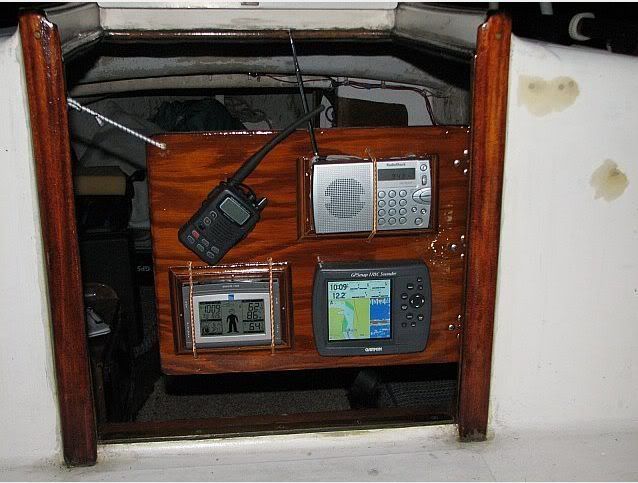
Chris Schoonmaker built this hinged panel för the electronic gadgets on his boat. Look for more pictures here.

Thursday, August 21, 2008

2008 summer cruise


I am just back from a three and a half week's cruise in the archipelago. A cruise report with pictures is posted on the Alacrity site so I will only post the link here.
Cruise report

Tuesday, August 5, 2008

A trip to the Ionian - part 4 (of 4)


Next day with light winds we headed north back to base at Platerias. The last day is always a bit sad but we had the last supper to look forward to. This would probably be combined with the aforementioned presentation. Mark hadn’t seen this as our last flotilla had been the first week of a two week cruise so there was no last supper for us. We spent most of the day bobbing about in peace and quiet until we saw a large tanker dead ahead of us some miles away. It was difficult to see if he was moving or not and I spent a long time watching him before deciding that if he was moving at all it was very slowly. After another half an hour I could see that he was moving from the bow wave that certainly hadn’t been there before. He was heading straight at us and although a long way off I decided to start the motor and head towards the land leaving him the channel. Our course was ninety degrees to his at that point but he must have altered course because he kept pointing at us. It was a good half an hour before I was sure he would pass by and he eventually cleared us by about half a mile. Not scary but just shows how careful you have to be.
Eventually we rounded the headland and the wind picked up. We were just off a close beat heading east into the Platerias channel which is a good couple of miles wide. Mark found his confidence and helmed as the speed picked up, allowing himself to play with sail settings and headings to get a feel for sailing. He got the hang of it and we hit 8 knots on the GPS at one point. Finally it was time for the drill: SAFER: Sails down, Anchor ready, Fenders out, Engine on, Ropes ready. We called in on the vhf for the last time and followed directions into the harbour where we moored and cleaned the boat.
That evening we walked for miles to the last taverna along the beach, at least it felt like miles. Measuring it on Google Earth made it only three quarters of a mile so it shows you what sort of condition we must be in! Anyway, it was worth the walk. The food was very good and low cost too. The local cats helped us finish it off and then the presentations began. We were called first and we braced ourselves for the onslaught, but no, we got the perfect crew award, no incidents or misbehaviour at all! They obviously missed me catching the anchor line at Parga!
So a great time was had, at a very reasonable price, and I hope to go as soon as possible again. Sailing Holidays come highly recommended and I’d be happy to be contacted if anyone has questions.
Tony Bennett