I recieved an email from Peter Jackson who is thinking about taking his Vivacity on a longer ocean passage.
"I want to take my Vivacity 20 to sea and I want to cross blue water – I’ve been told by the old guys in my club that it’s a stupid idea to even think of sailing any real distance away from the UK in a 20 footer. By the way they only use their boats as caravans so I’m not taking to much notice of them."
So here are my views on the topic:
Thanks for your email. You raise a very interesting topic and I am sure you will be getting very different answers from different people. Most will think that you should get the biggest boat you can afford. However, most people do indeed choose boats for their creature comforts rather than their seaworthyness.
I am myself, somewhat sickly perhaps, fascinated with small boat journeys and have read about quite a lot of them. If you boil the accounts down you get to some facts that may be considered.
As for the contra side first: there are mainly three disadvantages of sailing long ocean passages in a small boat. 1. the smaller the boat, the less wind you can sail in. That means in a gale, the smaller boat has to stop sailing actively and heave-to earlier. 2. the smaller boat cannot carry as much provisions and 3. the smaller boat sails more slowly, making the passage longer.
Now, I did not include accomodation comfort here for a reason. All small boat voyager's accounts tend to agree that a small cabin is a problem only at anchor. While sailing you are either lying down in your bunk, reading or sleeping or sitting down eating, drinking or navigating. You are not, very much walking around anyway.
On the plus side the accounts list: 1. A small boat does often sail dryer as it tends to float on top of the waves like a cork instead of thrusting itself into them like a bigger boat would. This, of course is highly depending on the circumstances like wave length and height, type av boat and so on. 2. A smaller boat is more easily handled, there is less load on the rigging and sails and you can manhandle everyting without the use of electric or mechanic devices that can fail. 3. A small boat is more rigid and less prone to damage. This of course applies to standard fiberglass boats only, steel boats or wooden boats have other characteristics. But a small fiberglass boat is like an eggshell, it's compactness makes it more resistant to impact. Also it is lighter, so the force on impact is less.
This for the general facts. Individually, boats of course are different. While many small boats have crossed oceans, there have been pointed out some things they should have rather than not. Main thing is a sheltered cockpit that cannot collect too much water if the boat is pooped. Here the Vivacity is not favored. It has a comparably large cockpit and not very efficient drains. So probably, if you are going, you should modify the cockpit, making it a little smaller and also make the hatches really watertight.
Now, finally, I am not sure if you are aware of the "
Vivacity Mini" website. That guy did some major alternations to his boat (adding a mizzen even) and then sailed it from the US to Hawaii. I am sure you won't really have to make that much changes to you boat to get out on the oceans, but it is at least proof that it can be done.
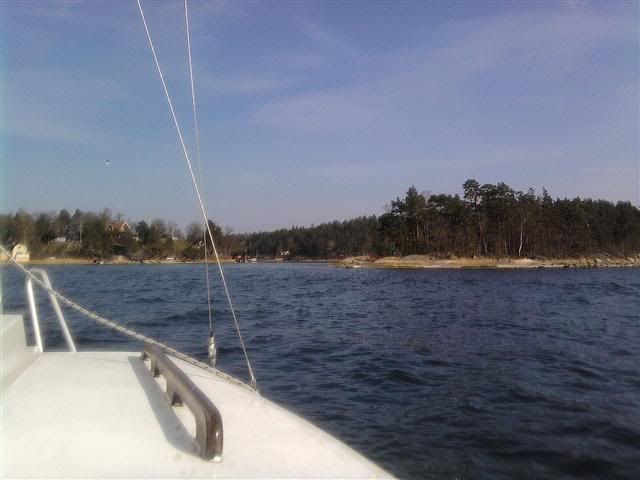
(Note: the pic shows Alacrity "
Hotfly" in a swell).


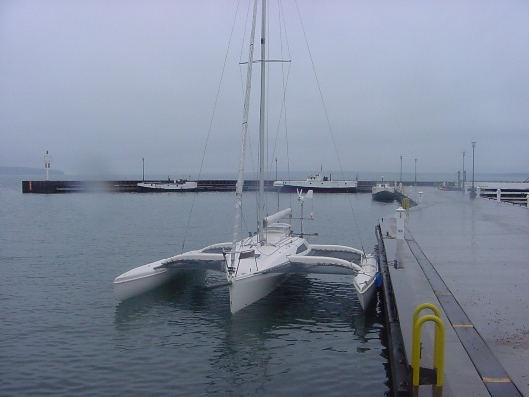 A fast trimaran is probably the most different kind of boat than a twin-keeler. Still, given my faiblesse for small boat adventures I just have to write about American "Captain Tommy's" epic voyage from the Great Lakes out to sea and then via the Nortwest Passage to Alaska. Yes, you go it right. Through the Northwest Passage, singlehanded in a 30-foot trimaran. Now 30 feet may not be small compared to other boats, but for this trip it's not a big boat.